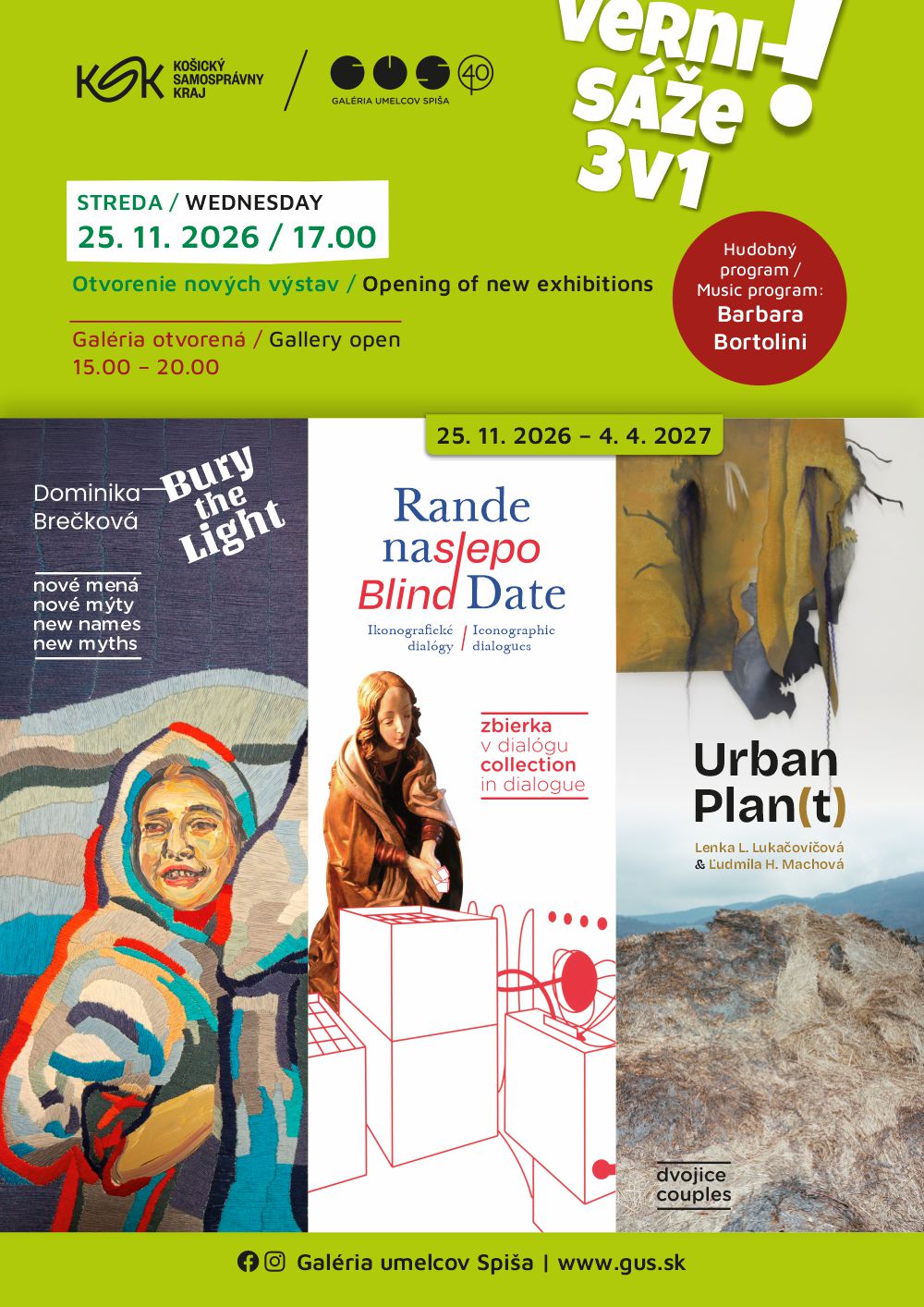
Presented for the first time, this series of paintings and its accompanying spatial and textile interventions draw attention to the questions of prejudice, memory and cultural understanding in the contemporary world. The artist probes the issues of identity, cultural stereotypes and the status of women in society. Part of the New Names – New Myths cycle of exhibitions.
_______
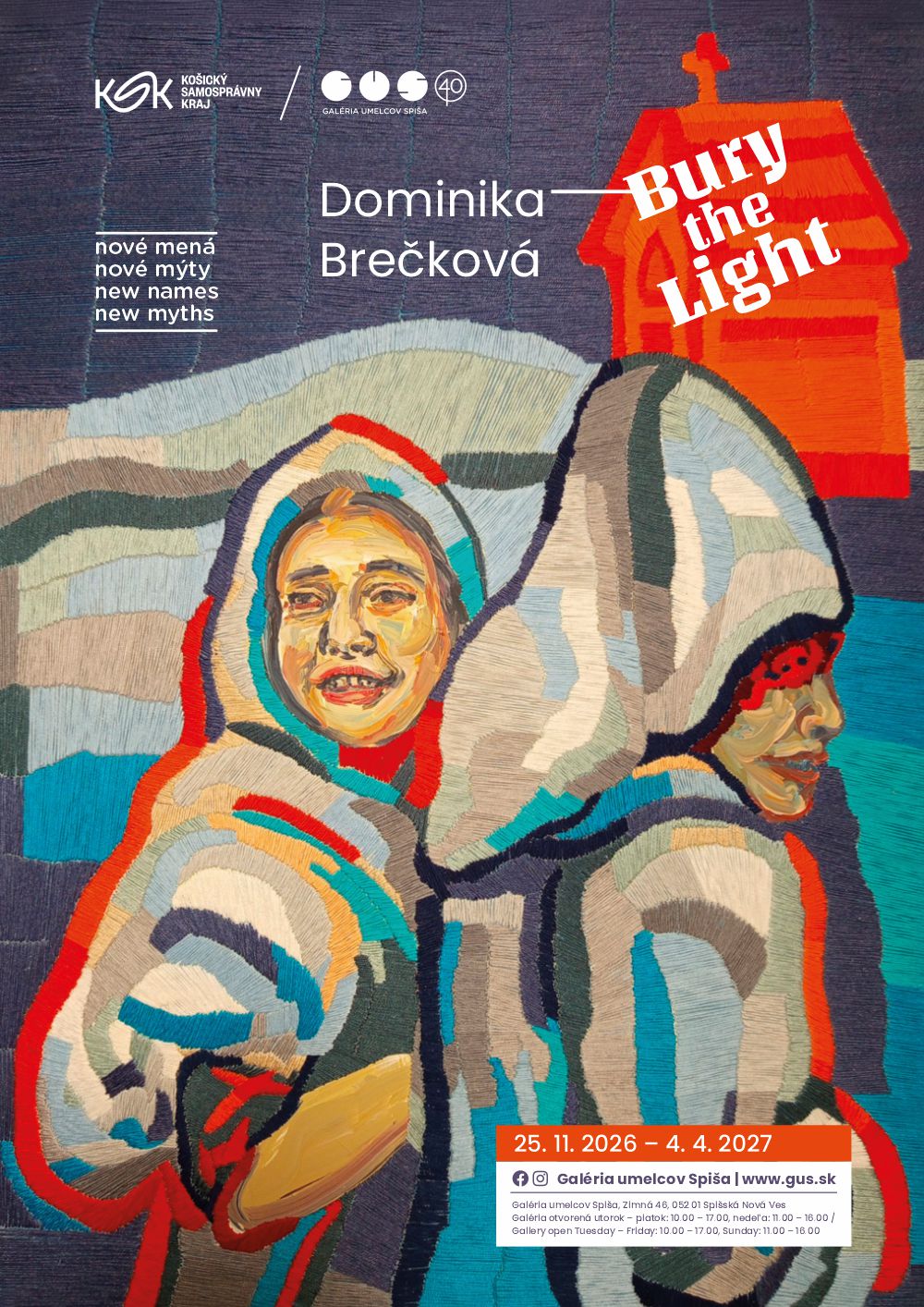
Even as a student, figure painting remained a central preoccupation of Dominika Brečková’s artistic approach. Her visual compositions and textile interventions reference both traditional Japanese culture and the more contemporary world of pop culture and video games, thereby offering a critical perspective on the superficial appropriation of these traditions within Western culture. Her style gradually evolved into its current form of expressive painting in which elements of embroidery, crochet and soft figural objects are intertwined; her most recent work develops this trend further, with Slovak and Japanese cultural references colliding in hybrid visual and conceptual encounters. Working playfully with parallels and paradoxes, her work offers a feminine perspective which challenges gender stereotypes within both a local and a wider context while also criticizing the superficial appropriation of cultural codes and symbols and the distortions and inappropriate meanings which this can entail.
Brečková’s art is a multilayered phenomenon, and her latest works relate the stories of female characters drawn from traditional local folklore, more specifically archetypal images of women and girls in folk costumes, a motif which has typically been associated with the patriarchal and nationalistic narratives of the local folk tradition. However, the artist revitalizes and activates these tropes within more contemporary contexts; we might even note the broader cultural relevance of this issue in the example of the tradwife, a concept which has gained a wider following through the advocacy of social media influencers and leading right-wing figures in the USA. While the women who feature in Brečková’s paintings are dressed in folk costume, they by no means conform to the expected gender-normative roles such as domesticity, modesty, physical attractiveness, self-sacrifice and passivity. The artist breaks down these concepts in her expressive paintings, dissecting her female characters, at times even exposing their innards using a poeticism reminiscent of the “body-horror” found in traditional Slovak folklore (Selfportrait; Lungs; Face down, all from 2025). The primal forces, emotions traumas and transgressions of the female characters are splayed out across viscerally expressive paintings and embroidered images, cast into a world of mythical power and animalistic narratives which are agonized, terrifying and intense, yet also ambivalent and ironic. The works depict scenes from the artist’s own local surroundings, and she applies an idiosyncratic and private sense of humour to cast a critical eye on the kitsch and absurdities that arise from amateur interpretations of traditional culture (Gýčové výjavy pod čerešňou [Kitsch Beneath the Cherry Tree], 2026).
Brečková constructs her own narrative apparatus, a feminine world into which is stirred an elixir composed of local folklore, Christian and pagan beliefs and various motifs drawn from mythology, Japanese culture and the personal iconography of her own past. As we peel back the skin of her female characters and her narratives, we encounter the unexpected and subversive (Čepčenie nevesty [Seeking the bride’s hand], 2023); within a single work we can encounter characters, symbols, rites and elements from a multitude of worlds – girls from folk tales, Princess Hashihime, the deity whose jealousy symbolizes romantic breakups, the Slavic goddesses Morena and Kupalo, icons of Christian saints, but also demonic figures such as Nure-onna from the ranks of the Japanese spirits known as the yōkai. Nonetheless, none of the cast of characters in her work appear at random, and the unexpected yet deliberate juxtapositions which they form are the means by which the artist fosters her critical and poetic language.
Brečková’s work covers a wide range of artistic approaches, including the afore-mentioned embroidery and crocheting which she applies in creating soft objects and textile-based figural sculptures. These standalone works and smaller elements are often integrated into the pictorial plane, but they can also stand as autonomous spatial manifestations. In the exhibition, they are mainly found in the form of demonic female entities drawn from Japanese mythology, beings whose precise nature remains ambiguous (Hadia žena [Snake woman], 2024; Sakura head, 2025; Flying bold, 2024).
Dominika Brečková brings a sense of authenticity and veracity to all of the creative fields and forms of visual art in which she works. Her art is a multilayered visual experience which is combined with a searing assertion of selfhood and gender.
Mgr. art. Michaela Šuranská, ArtD.,
exhibition curator
_______
About artist
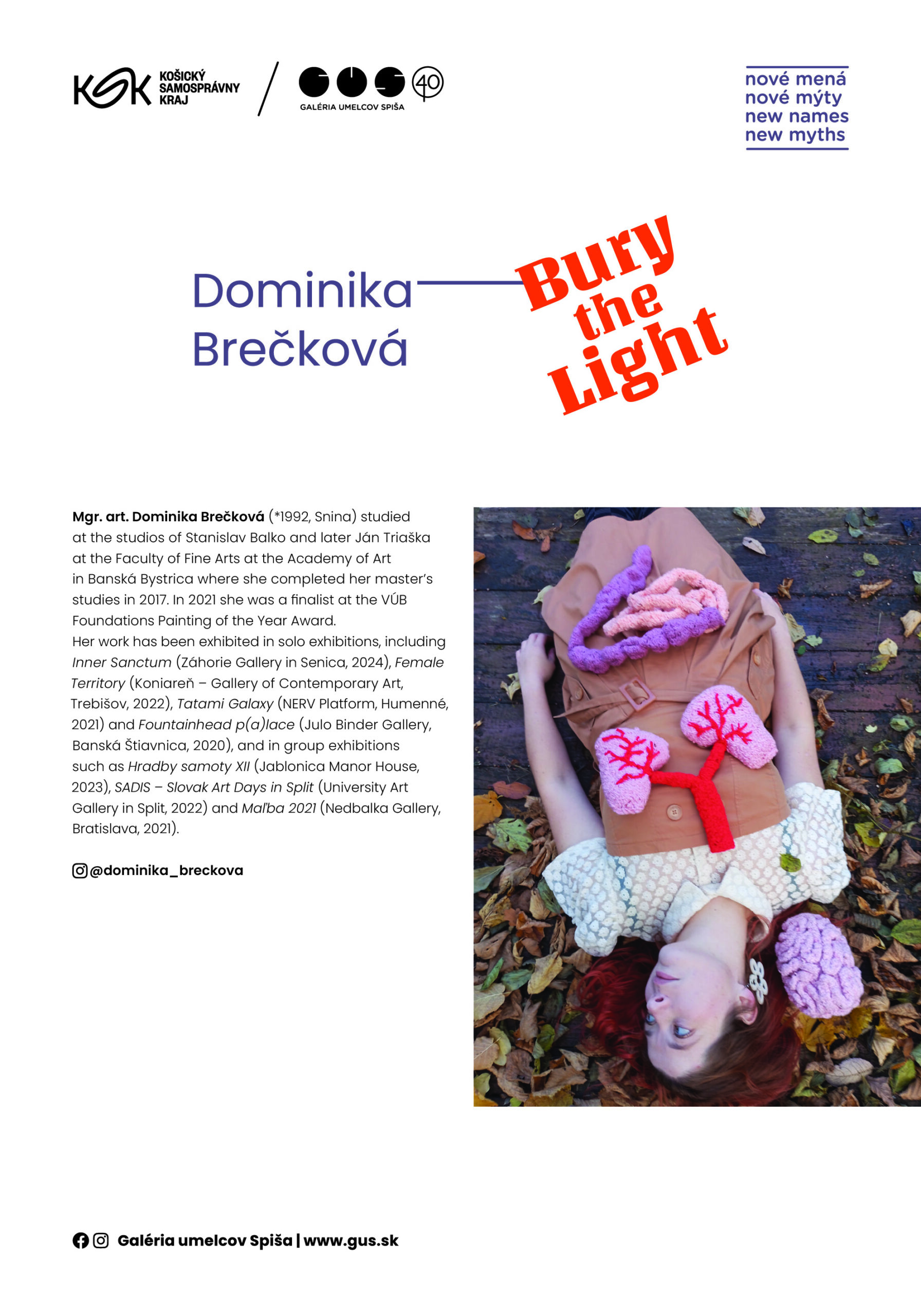
Mgr. art. Dominika Brečková (*1992, Snina) studied at the studios of Stanislav Balko and later Ján Triaška at the Faculty of Fine Arts at the Academy of Art in Banská Bystrica where she completed her master’s studies in 2017. In 2021 she was a finalist at the VÚB Foundations Painting of the Year Award. Her work has been exhibited in solo exhibitions, including Inner Sanctum (Záhorie Gallery in Senica, 2024), Female Territory (Koniareň – Gallery of Contemporary Art, Trebišov, 2022), Tatami Galaxy (NERV Platform, Humenné, 2021) and Fountainhead p(a)lace (Julo Binder Gallery, Banská Štiavnica, 2020), and in group exhibitions such as Hradby samoty XII (Jablonica Manor House, 2023), SADIS – Slovak Art Days in Split (University Art Gallery in Split, 2022) and Maľba 2021 (Nedbalka Gallery, Bratislava, 2021).
Curator: Mgr. art. Michaela Šuranská, ArtD.
Professional Collaboration: Mgr. Lucia Benická – GUS
Production: Mgr. Mária Šabľová, MBA – GUS
Graphic design: Mgr. art. Ivana Babejová, ArtD. – GUS
Translation: Bc. Gavin Cowper
Opening of exhibition
25. 11. 2026 at 5:00 PM
Venue
Galéria umelcov Spiša
Zimná 46, Spišská Nová Ves
Duration date
25. 11. 2026 – 4. 4. 2027