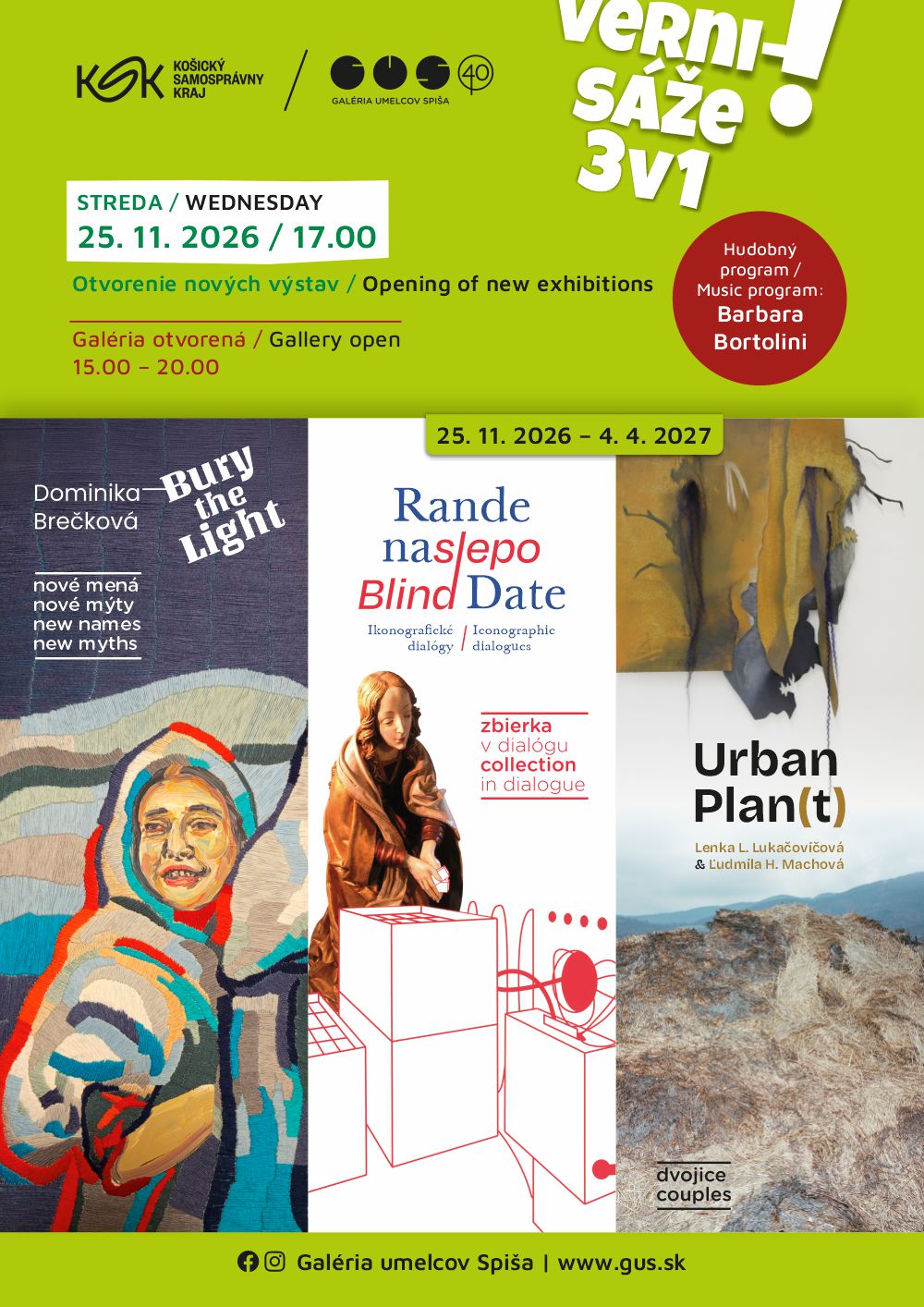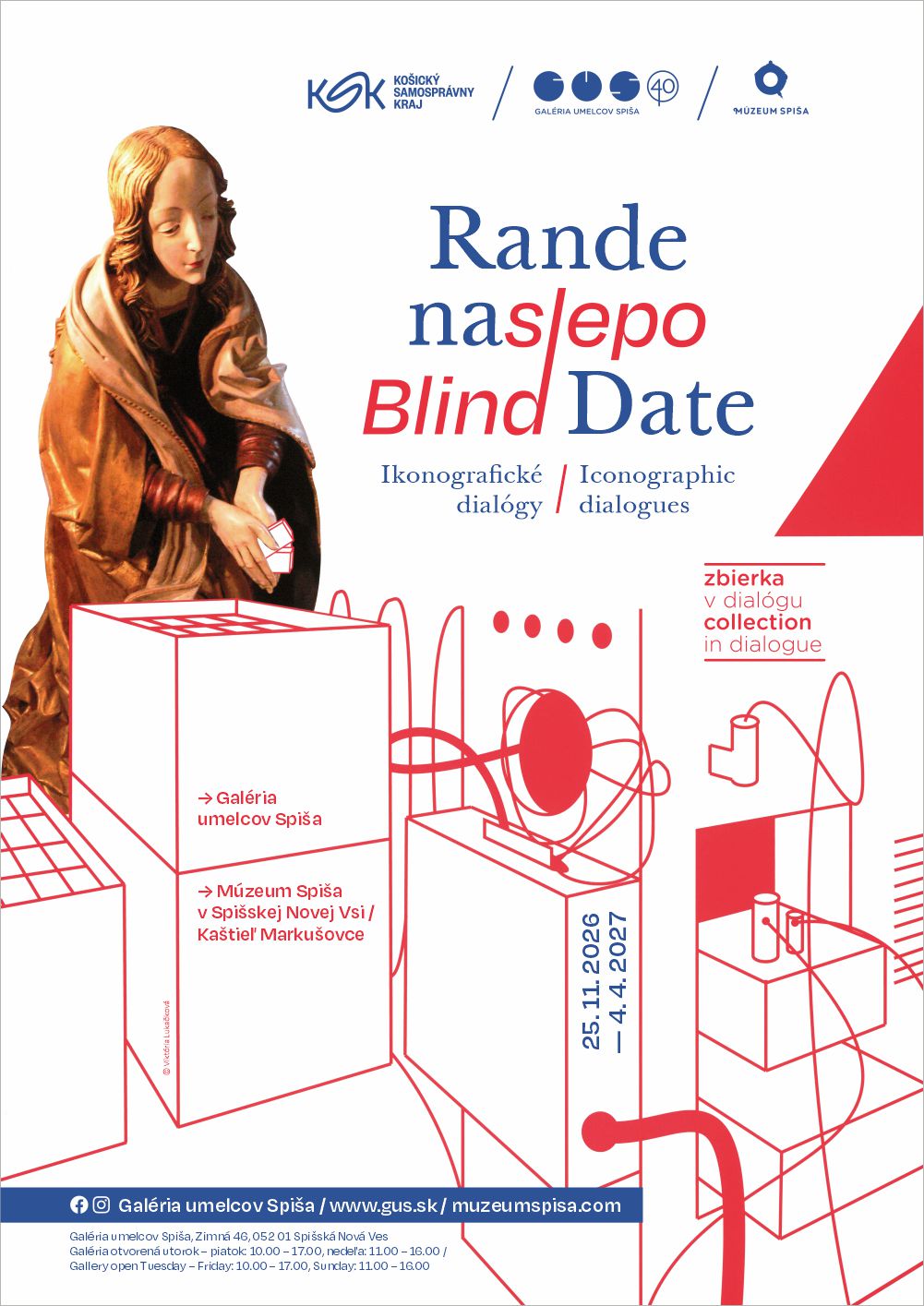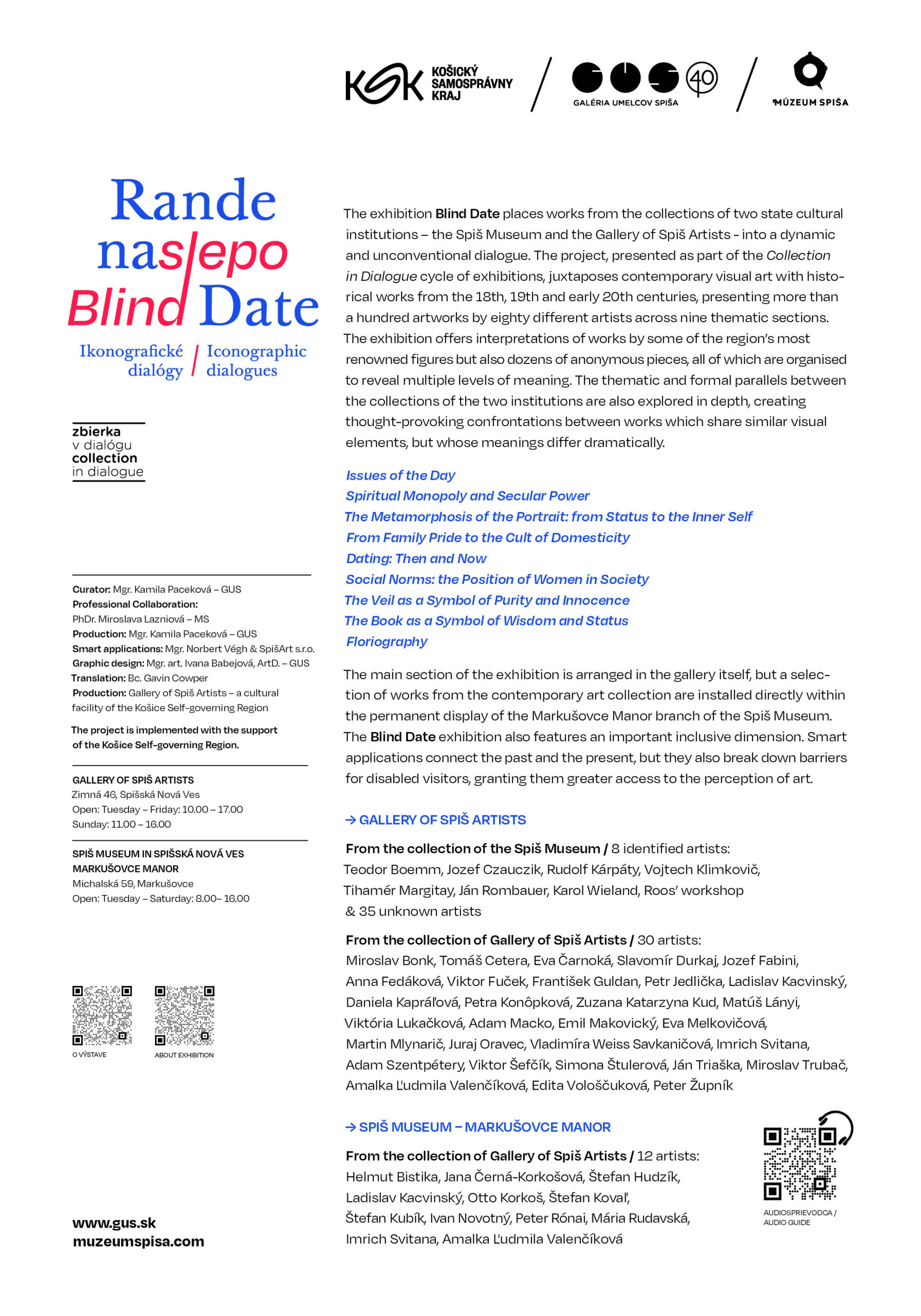
The concept of the exhibition Blind Date: Iconographic Dialogues is based around the juxtaposition of contemporary art from the collection of the Gallery of Spiš Artists with more historical works from the collection of the Spiš Museum in Spišská Nová Ves. The exploration of visual, thematic and symbolic correlations fosters a dynamic and unconventional dialogue between “old” and “new” art. The exhibition offers different interpretations of the thematic and formal parallels between the collections of the two institutions across nine thematic sections which present thought-provoking confrontations between works which share similar visual elements, but whose meanings differ dramatically.
Featured works by renowned artists from earlier generations (such as Teodor Boemm, Jozef Czauczik, Rudolf Kárpáty, Vojtech Klimkovič, Tihamér Margitay, Ján Rombauer and Karol Wieland) highlight the rich artistic tradition which has played a formative role in the development of the Spiš region. At the same time, however, we should bear in mind that a significant part of the Museum’s collection is comprised of anonymous works, a fact which also indicates its potential for future academic research and attributions in the field of art history.
The theme of Issues of the Day is introduced by a direct comparison between two works which offer contrasting reflections on both the crises of their respective periods and the ways in which people responded to them – Tornado by Slavomír Durkaj (M 2043) and an anonymous work titled Čáki v jazdeckej uniforme na koni [Csáky on horseback in riding attire] (S1965/43). Although the two works emerged from very different historical and social contexts, they reveal a shared concern with the issues of survival, security and the future of society. In the past, these themes typically played out in struggles over power, territory and status, often resulting in military conflict. Perhaps the most pressing issue of the contemporary era is that of climate change, but we are rising to the challenges which this crisis poses through cooperation, science and the protection of the natural environment. Durkaj’s art critiques contemporary society using a generous dose of irony and absurdity, and many of his compositions allude to the threat of ecological catastrophe or apocalypse and other issues of the present day such as the pollution of the natural world and the conflict between nature and civilization. A feature common to both works is the effort of humankind to secure a future for itself. The difference between the two lies in the means by which this can be achieved – where power and military force once prevailed, the crucial factors in the world of today are cooperation and responsibility.
The theme of Spiritual Monopoly and Secular Power reflects on new forms of worship – exploring how the modern deity of marketing has seized control of the absolute power once wielded by bishops and kings.
The thematic section titled The Metamorphosis of the Portrait: From Status to the Inner Self examines the various approaches to the genre of portraiture. The overview maps the shift from classical representative paintings towards deep introspective perspectives – assertions of social status give way to the unmasking of the psyche and the anxiety and uncertainty of the modern identity.
The theme From Family Pride to the Cult of Domesticity confronts the Romanticizing depiction of Spiš Castle as a status symbol in the work of Vojtech Klimkovič with the ironically situated view from the window of the banal, greyed-out kitchen in the painting by Vladimíra Weiss Savkaničová.
The next section, Dating: Now and Then compares courtship across different eras and the influence of social norms and values in each period. Courtship was a far more formalized process in the 19th century and was strictly conditioned by social conventions and the crucial role which it played in the nexus of family, social status and property. In the 21st century, however, dating is a far more spontaneous and individualistic affair, especially in light of the new possibilities opened up by social media and dating apps. Regardless of these changes, however, the ultimate goal remains unchanged: the need to form partnerships and relationships.
The theme of Social Norms: the Position of Women in Society juxtaposes a plaster cast of the Madonna from Master Pavol’s Altar of the Nativity in Levoča with a graphic print by Viktória Lukačková. The social status of women has varied greatly over the centuries. Women were traditionally relegated to the role of wife and mother, and their social possibilities were therefore greatly restricted. Over time, however, they gained a greater degree of freedom and equality. Lukačková reworks the common trope of the Madonna and relocates her to an industrial setting, thereby confronting religious traditions with the reality of contemporary globalized society.
Intriguing symbolic correlations and connotations appear throughout the thematic sections. The theme of The Veil as a Symbol of Purity and Innocence contrasts a sculpture by the contemporary artist Amalka Ľudmila Valenčíková with a mid-19th century work by Karol Wieland depicting a veiled woman in a blue gown.
The theme of The Book as a Symbol of Wisdom and Status compares a work by Anna Fedáková titled Preniknutie [Penetration] (P 1787) with the oil painting Portrét dámy v bielom [Portrait of a Woman in White] (S1969/121). The painting bears many of the characteristic traits of the sentimental, academic portrait style of its period; the bucolic background and the book which the subject holds in her hand are emblems of her education, sensitivity and spiritual profundity. In Fedáková’s work, the book is a symbol of the integral nature of thought and knowledge.
The theme of Floriography juxtaposes a variety of artistic approaches to the depiction of floral motifs – in historical art, the image of the rose was used solely to express the character of the subject, but the flower has been granted absolute autonomy in contemporary art, emerging as a subject in its own right.
Many of the works are interpreted on the basis of their visual similarities (such as the use of floral or animal motifs and ornamentation) and their formal relationships. The exhibition draws attention to symbolic parallels (such as the motif of the cross and other sacral scenes with profane details) and variations on the still life genre, but it also explores the use of allegory in fine art and its parallels with different appropriations and allusions drawn from the history of art. The exhibition space is also enhanced by the inclusion of historical furniture, objects and interior decorations.
The Blind Date: Iconographic Dialogue project also places a strong focus
on the active integration of visitors with disabilities. The exhibition features an inclusive dimension in the form of interactive tools which aim to improve accessibility for blind visitors or those with visual impairments (such as haptic replicas of exhibited works, text-based materials and Braille labels) and also for those with hearing difficulties (information videos in sign language). We also offer an audio guide to the exhibition featuring detailed descriptions and comparisons of selected works and this is intended for use by all visitors. Interactive educational tools are also available which give the general public the opportunity to learn the basics of reading in Braille.
The exhibition is not only a powerful aesthetic experience but also a thought provoking reflection on the continuity of art and its capacity to connect the past with the present; the dialogues which the exhibition fosters can also greatly enrich our understanding of the artworks themselves.
Mgr. Kamila Paceková,
exhibition curator – GUS
Curator: Mgr. Kamila Paceková – GUS
Professional Collaboration: PhDr. Miroslava Lazniová – MS
Production: Mgr. Kamila Paceková – GUS
Smart applications: Mgr. Norbert Végh & SpišArt s.r.o.
Graphic design: Mgr. art. Ivana Babejová, ArtD. – GUS
Translation: Bc. Gavin Cowper
Opening of exhibition
25. 11. 2026 at 5:00 PM
Venue
Galéria umelcov Spiša
Zimná 46, Spišská Nová Ves
Duration date
25. 11. 2026 – 4. 4. 2027